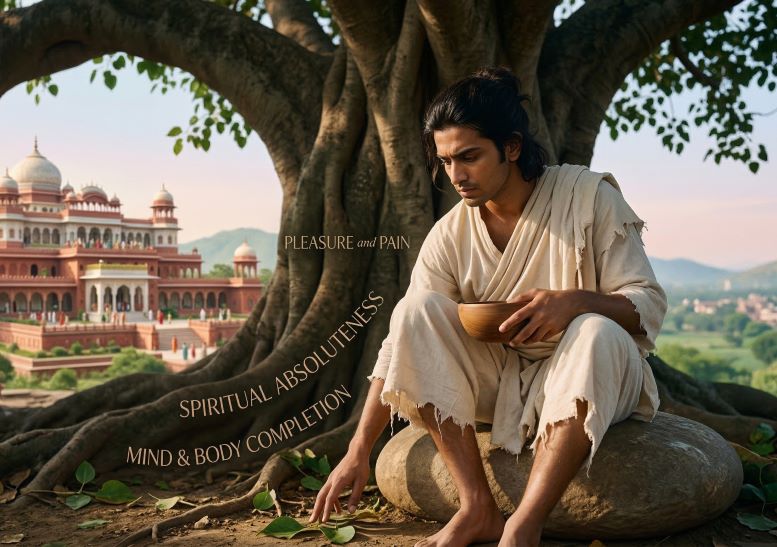
We often think of spiritual enlightenment as a peaceful, static state. But the truth behind my Pleasure and Pain: Spiritual Absoluteness series is rooted in a much more turbulent reality. It is a journey modeled after the man who would become the Buddha—a man who had to master the extremes of the physical world before he could unlock the mind.
The Myth of the “Perfect” Start
Before he was the Buddha, he was Siddhartha Gautama, a prince and a future king. He lived a life of absolute sensory pleasure. His father, seeking to protect him from the harshness of reality, surrounded him with:
- Physical Perfection: The finest silks, the best food, and constant entertainment.
- Total Insulation: He was forbidden from seeing sickness, old age, or death.
This was the “Pleasure” phase. But as Siddhartha eventually realized, a life of only pleasure is a life of half-truths. It is a gilded cage that keeps the mind stagnant.
The Radical Shift to Pain
When Siddhartha finally saw the “Four Sights” (an old man, a sick man, a corpse, and an ascetic), his world shattered. He didn’t just step away from his kingship; he sprinted to the opposite extreme.
He spent years as an ascetic, pushing his body to the brink of starvation and exhaustion. He traded the palace for the dirt, believing that by punishing the Body, he could liberate the Mind.
The Realization: Mind and Body Completion
The “Aha!” moment—the core of our Mind and Body Completion course—came when Siddhartha realized that neither extreme worked.
- Pure Pleasure led to attachment and ignorance.
- Pure Pain led to physical weakness and mental fog.
True “Spiritual Absoluteness” was found in the Middle Way. He realized that the mind cannot reach its highest frequency if the body is either over-indulged or utterly broken. You must integrate both experiences to transcend them.
“Just as a lute produces the right tone only when the strings are neither too tight nor too loose, the human spirit reaches completion only when mind and body are in precise alignment.”
What This Means for You
In the Pleasure and Pain series, we don’t ask you to become a monk or a king. We ask you to look at the “palaces” and “deserts” in your own life. We use these ancient principles to:
- Audit your sensory inputs: Are you numbing yourself with pleasure?
- Strengthen your discipline: Are you avoiding the “productive pain” necessary for growth?
- Achieve Completion: Bringing the physical vessel and the spiritual mind into a singular, absolute state of being.
Siddhartha had to lose a kingdom to find himself. You only have to be willing to look at your life through the lens of the Middle Way.